Application Guide
Quartz Glass Applications: A Buyer's Guide to Types, Grades, and Sourcing
Learn how to select and source quartz glass for optics, semiconductor, laboratory, and lighting applications — including glass types, quality specs, and supplier evaluation.
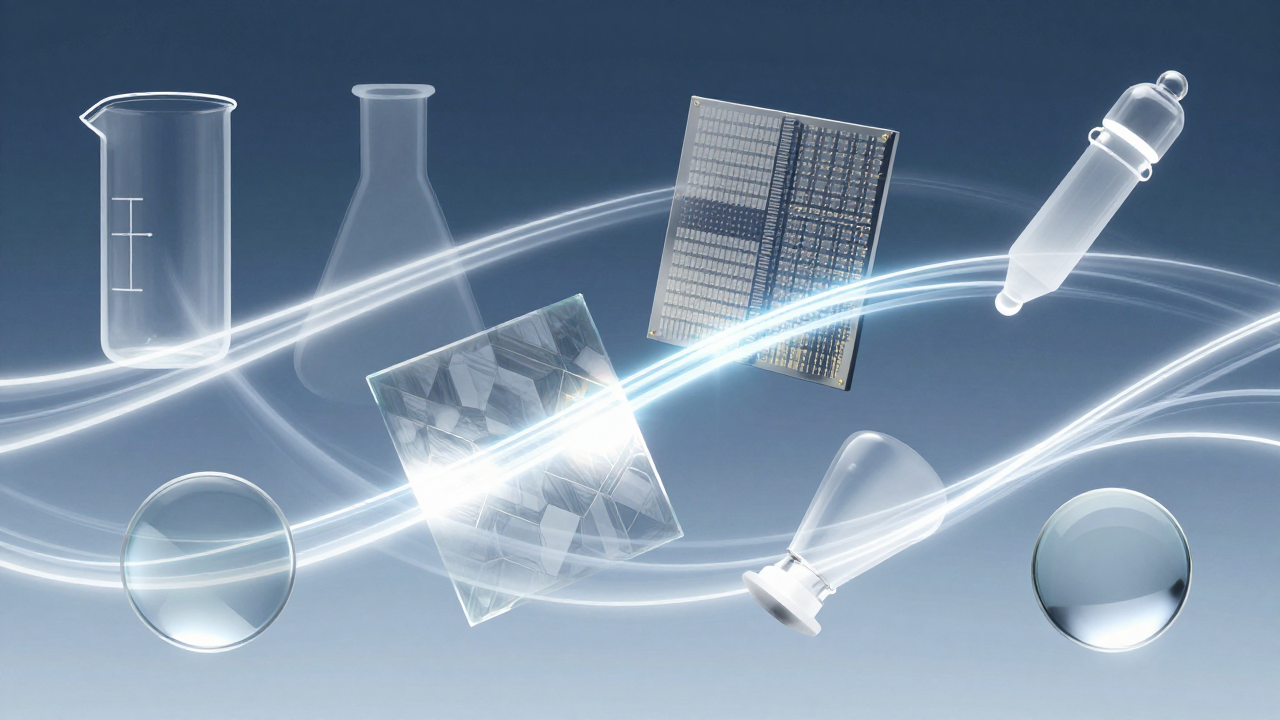
## Overview
Quartz glass (fused silica glass) is used across a wide range of industries — from semiconductor manufacturing and precision optics to laboratory instrumentation and industrial lighting. However, not all quartz glass is the same. The type, purity grade, and manufacturing method directly affect performance, cost, and suitability for each application.
This guide helps buyers understand the key differences between quartz glass types, verify quality specifications, and prepare effective sourcing inquiries.
## Quartz glass types
### Transparent quartz glass
The highest optical quality grade, produced from high-purity synthetic or natural raw materials. It offers excellent transmission from deep UV (180nm) through visible to near-infrared (3,500nm).
**Best for**: Optical lenses, semiconductor wafer carriers, UV lamp envelopes, precision cuvettes, sight glasses, and analytical instruments.
**Key specs to request**: SiO₂ purity ≥99.95%, OH content (low-OH for IR applications, standard for UV), bubble class (A or B), and dimensional tolerances.
### Translucent quartz glass
Allows diffuse light transmission but not clear image formation. Produced from natural quartz with slightly higher impurity levels.
**Best for**: Infrared heater tubes, furnace sight tubes, thermal insulation components, and diffusion furnace liners.
**Key specs to request**: SiO₂ purity ≥99.5%, thermal conductivity, and mechanical strength at operating temperature.
### Opaque quartz glass
Contains controlled bubbles that scatter light, providing excellent thermal insulation. The trapped gas bubbles reduce heat transfer.
**Best for**: Furnace linings, radiant heater sheaths, thermal barriers, and insulation panels.
**Key specs to request**: Bubble distribution density, thermal conductivity, and maximum continuous operating temperature.
## Applications by industry
### Semiconductor manufacturing
Quartz glass is essential in semiconductor fabrication. Key components include:
- **Diffusion tubes and boats**: Must withstand repeated thermal cycling to 1,100–1,200°C in corrosive gas environments
- **Wafer carriers (Jigs)**: Dimensionally stable at high temperature, low particle generation
- **Lithography optics**: Extremely high purity and homogeneity for deep UV exposure systems
- **Bell jars and chambers**: Chemical inertness during deposition and etching processes
### Optics and photonics
- **UV-VIS-IR lenses and windows**: Transmission >85% across target wavelengths
- **Prisms and beam splitters**: Precise refractive index control (1.4585 at 589nm)
- **Fiber optic preforms**: Synthetic fused silica with ultra-low OH content
- **Laser optics**: High damage threshold for high-power applications
### Laboratory and analytical
- **Cuvettes and cells**: Chemical inertness, optical clarity for spectrophotometry
- **Reaction tubes**: Thermal shock resistance for rapid heating/cooling cycles
- **Crucibles and sample holders**: Minimal contamination for analytical work
### Lighting industry
- **UV lamp envelopes**: Transparent grade with high UV transmission
- **Halogen lamp bulbs**: Thermal shock resistance at 800–900°C continuous operation
- **LED encapsulation components**: Optical clarity and thermal stability
## Quality specifications to verify
| Parameter | What to Check | Typical Method |
|-----------|--------------|----------------|
| SiO₂ purity | ≥99.95% for optical, ≥99.5% for industrial | Chemical analysis (ICP-OES) |
| OH content | Low-OH (<10 ppm) for IR, standard (200–1,200 ppm) for UV | Infrared spectroscopy |
| Bubble class | Class A (minimal), B (moderate), C (standard) | Visual inspection per standard |
| Dimensional tolerance | ±0.5mm standard, ±0.1mm precision | Precision measurement |
| Striae grade | Grade A (none visible), B (minor) | Polarized light inspection |
| Thermal shock resistance | ΔT >1,000°C without fracture | Thermal cycling test |
## Cost considerations
Quartz glass pricing varies significantly based on:
1. **Raw material source**: Synthetic silica (higher cost, highest purity) vs. natural quartz (lower cost, adequate for most industrial uses)
2. **Glass type**: Transparent > translucent > opaque (in terms of cost)
3. **Purity grade**: Each additional "nine" of purity (99.9% → 99.99% → 99.999%) increases cost substantially
4. **Dimensional precision**: Tighter tolerances require additional grinding and polishing steps
5. **Form factor**: Tubes, rods, plates, and custom shapes each have different processing costs
6. **Volume**: Custom shapes in small quantities are significantly more expensive per unit than standard sizes
## Sourcing tips
1. **Specify the application first** — suppliers can recommend the most cost-effective grade
2. **Request TDS with each batch** — verify consistency across shipments
3. **Ask about raw material source** — synthetic vs. natural affects purity and price
4. **Confirm dimensional specs early** — rework is expensive and delays delivery
5. **Plan for qualification samples** — test material performance before committing to volume orders
6. **Discuss packaging** — quartz glass is fragile; ensure adequate protection for international shipping
## What buyers should clarify
Before contacting a supplier, prepare the following: target application and operating environment, required glass type (transparent, translucent, or opaque), minimum SiO₂ purity grade, OH content requirement, dimensional specifications with tolerances, expected monthly or quarterly volume, and any specific industry certifications needed.
## Why it matters
Selecting the wrong quartz glass grade leads to premature component failure, degraded optical performance, contamination in semiconductor processes, or unnecessary cost overruns. Understanding these specifications before inquiry reduces trial-and-error and accelerates the sourcing process.